Online stores
An online store people actually finish buying from.
I build Shopify stores for Canadian businesses — the product pages, the shipping rules, the tax settings, the emails that go out after someone orders. The unglamorous parts are the ones that decide whether a cart turns into a sale.

Knee brace, size M
Free size exchange · Insurance receipt
$189
- Shipping to Calgary, ABFree
- GST (5%)$9.45
- Apple Pay•••• 4021
Confirmation email sent · Ships tomorrow
In short
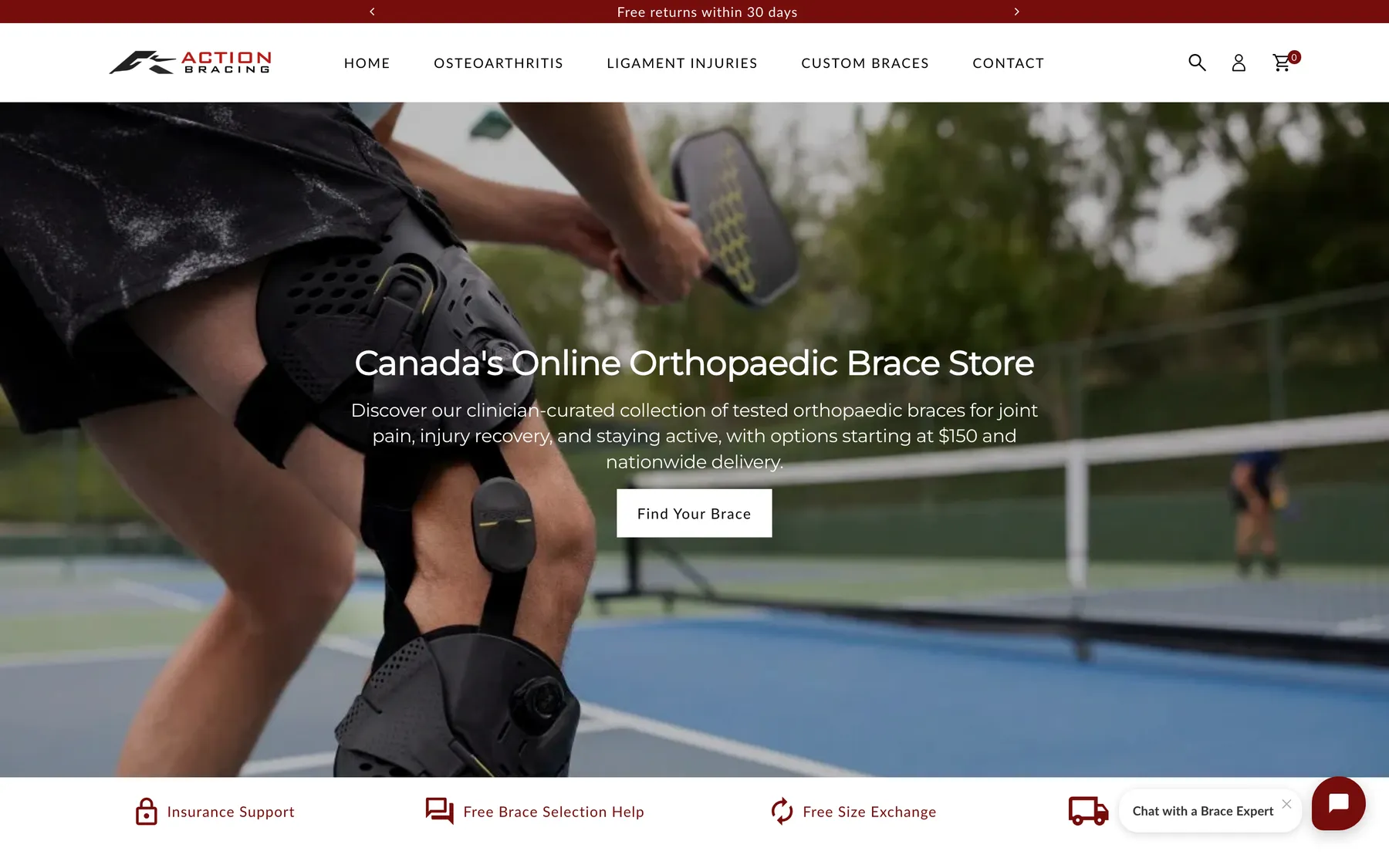
Joelle builds and sets up Shopify stores for small businesses in Canada, covering store design, product pages, Canadian shipping and tax configuration, payment setup, and the automated order and abandoned-cart emails. She built Action Bracing, a national Canadian orthopaedic brace store, from a single page on a clinic website.
What’s included
What you get.
Every project, as standard. Nothing here is an add-on.
01
Product pages that answer the question
Sizing, shipping time, return policy, and what it's actually for — visible without scrolling. Most abandoned carts are just an unanswered question.
02
Canadian shipping and tax, set up right
GST and provincial tax by destination, real carrier rates, and a free-shipping threshold that doesn't quietly cost you money on every order to Nunavut.
03
A checkout with nothing in the way
Guest checkout on, address autocomplete on, wallets enabled. Every extra field is a percentage of people gone.
04
The emails that come after
Order confirmation, shipping notice, abandoned cart, and a review request. These are the highest-earning emails a store sends and most stores never touch the defaults.
05
Finding the right product
Filters, a size guide, or a short quiz when the range is complicated — like the brace finder on Action Bracing, which turns 'my knee hurts' into one product.
06
Set up to be found
Product schema so your items can show with price and availability directly in Google results, plus collection pages written for what people search.
Usually a good fit for…
- Shops moving from in-person-only to selling online
- Businesses with one product page buried inside a service site
- Anyone on a store that's slow, ugly, or impossible to update
- Canadian sellers who need tax and shipping to just be correct
Online stores — questions people ask
Shopify or WooCommerce — which should I use?
Shopify for almost every small business. It handles payments, taxes, security and updates for you, and the monthly fee is less than what fixing a broken WooCommerce plugin costs once. WooCommerce makes sense if you already run WordPress and sell only a handful of items.
How much does it cost to set up a Shopify store?
The build is a fixed quote depending on how many products you have and whether your product photos and descriptions exist yet. On top of that Shopify itself starts around $51 CAD a month, plus roughly 2.9% and 30¢ per transaction. TODO: replace with Joelle's real build range.
Can you move my existing store to Shopify?
Yes — products, customers, orders and URL redirects so you don't lose the Google rankings you already have. Redirects are the step most migrations skip, and it's the one that costs traffic.
Do you handle the product photos and descriptions?
I write descriptions with you. For photography I'll point you at a Calgary photographer, or show you how to shoot flat product photos yourself with a phone and a window — for a lot of products that's genuinely enough.
Will my products show up on Google Shopping?
The store is set up so they can. Every product page carries structured data with price and stock status, and I connect the store to a Google Merchant Center feed. Whether you then pay for Shopping ads is up to you.
Also worth a look
Let’s talk about your business.
Tell me what you do and what you need. I’ll reply within a day, usually with a couple of questions and a rough idea of cost.